Katakana Chart — Complete Reference with All 71 Characters
Looking for a complete katakana chart? Whether you're a beginner just starting Japanese or you need a quick reference while reading, this page has everything you need. Below you'll find a downloadable katakana table covering all 71 standard characters — 46 basic plus 25 dakuten and handakuten — with romaji readings and pronunciation tips.
📋 Table of Contents
Katakana (カタカナ) is one of three Japanese writing systems, alongside hiragana and kanji. While hiragana is used for native Japanese words and grammar, katakana handles foreign loan words, names, onomatopoeia, and emphasis. Modern Japanese is full of katakana — you'll see it on menus (コーヒー = coffee), in technology (パソコン = computer), and throughout everyday life.
If you haven't learned hiragana yet, start with our hiragana chart first — the sounds are identical, so hiragana knowledge makes katakana much easier.
Complete Katakana Chart (Downloadable)
Here's our full katakana reference chart with all 71 characters organized in the traditional gojūon (五十音) order. Right-click or long-press to save it.
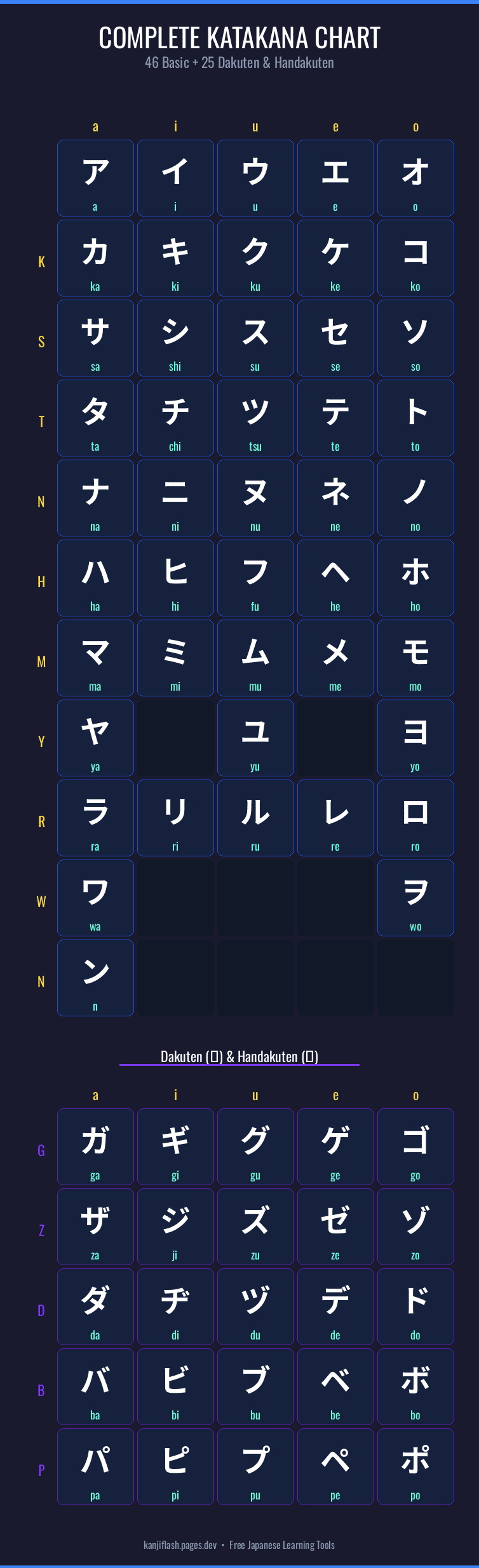
This chart includes the 46 basic katakana in the main grid and all 25 dakuten/handakuten characters in a separate section below. Each character shows its romaji (Roman letter) pronunciation underneath.
Download the full-resolution chart for printing or offline reference — it's designed to be clear and readable at any size.
How to Read the Katakana Chart
The chart is organized in the traditional Japanese gojūon (fifty sounds) order:
- Columns represent the five vowels: ア (a), イ (i), ウ (u), エ (e), オ (o)
- Rows represent consonant groups: K, S, T, N, H, M, Y, R, W, plus the standalone ン (n)
To find any character, locate the consonant row and vowel column. For example: カ (ka) is at the K-row, A-column intersection.
This grid system is how Japanese dictionaries are organized, so learning it now pays off throughout your Japanese studies.
The 46 Basic Katakana Characters
The basic katakana cover all the fundamental sounds in Japanese. Here they are organized by consonant group:
Vowels (母音): ア a · イ i · ウ u · エ e · オ o
K-row: カ ka · キ ki · ク ku · ケ ke · コ ko
S-row: サ sa · シ shi · ス su · セ se · ソ so
T-row: タ ta · チ chi · ツ tsu · テ te · ト to
N-row: ナ na · ニ ni · ヌ nu · ネ ne · ノ no
H-row: ハ ha · ヒ hi · フ fu · ヘ he · ホ ho
M-row: マ ma · ミ mi · ム mu · メ me · モ mo
Y-row: ヤ ya · ユ yu · ヨ yo
R-row: ラ ra · リ ri · ル ru · レ re · ロ ro
W-row: ワ wa · ヲ wo
Nasal: ン n
Notice that katakana characters are more angular and geometric than hiragana. This actually helps in practice — katakana words often stand out visually in a Japanese text, making them easy to spot.
Dakuten & Handakuten (Voiced Sounds)
Adding two small marks changes the pronunciation of certain katakana:
Dakuten (゛) — two small strokes that voice the consonant:
- G-row: ガ ga · ギ gi · グ gu · ゲ ge · ゴ go (from K-row)
- Z-row: ザ za · ジ ji · ズ zu · ゼ ze · ゾ zo (from S-row)
- D-row: ダ da · ヂ di · ヅ du · デ de · ド do (from T-row)
- B-row: バ ba · ビ bi · ブ bu · ベ be · ボ bo (from H-row)
Handakuten (゜) — a small circle that creates a "p" sound:
- P-row: パ pa · ピ pi · プ pu · ペ pe · ポ po (from H-row)
These are logical extensions — once you know the base character, just add the mark. K→G, S→Z, T→D, H→B (dakuten) or H→P (handakuten).
Commonly Confused Katakana Pairs
One of the biggest challenges with katakana is that several characters look very similar. Here are the pairs that trip up most learners:
シ (shi) vs ツ (tsu): Both have two small strokes and one long stroke. The key difference is stroke direction — シ has more horizontal strokes flowing to the right, while ツ has more vertical strokes flowing downward. Think: シ smiles sideways, ツ cries downward.
ソ (so) vs ン (n): Similar issue — ソ has a steeper, more vertical long stroke, while ン has a flatter, more horizontal one. ソ drops down, ン sweeps across.
ノ (no) vs メ (me): ノ is just one diagonal stroke. メ adds a second crossing stroke. Simple, but easy to mix up at speed.
ク (ku) vs ケ (ke): ケ has an extra horizontal stroke at the top-right. Think of the extra stroke as the "e" tag.
ウ (u) vs ワ (wa): ワ has a slight opening at the bottom-right that ウ doesn't. Subtle but important.
Study tip: When you encounter these pairs, practice writing them side by side repeatedly. Your hand will learn the difference even when your eyes are unsure.
Katakana in the Real World
Unlike hiragana, which you'll use for grammar and native words, katakana shows up in very specific contexts:
Foreign loan words (外来語): The vast majority of katakana usage. Japan borrows heavily from English and other languages:
- コンピューター (konpyūtā) = computer
- レストラン (resutoran) = restaurant
- アイスクリーム (aisukurīmu) = ice cream
- チョコレート (chokorēto) = chocolate
Foreign names: Your name will be written in katakana in Japan. For example, マイケル (Maikeru = Michael) or エミリー (Emirī = Emily).
Onomatopoeia: Japanese has hundreds of sound words written in katakana: ワンワン (wan wan = woof), ニャー (nyā = meow), ドキドキ (doki doki = heartbeat/nervous).
Emphasis: Similar to italics or bold in English. Advertisers love katakana for impact.
Scientific terms: Plant and animal names in academic contexts are often written in katakana.
Tips for Memorizing Katakana Faster
1. Learn in groups, not randomly. Study one consonant row per day (5 characters). The K-row (カキクケコ) on Monday, S-row (サシスセソ) on Tuesday, and so on. You'll cover all 46 in under two weeks.
2. Use spaced repetition. Apps like Kana Flash use SRS algorithms to show you characters right before you'd forget them. This is scientifically the most efficient memorization method.
3. Read katakana in the wild. Once you know even a few characters, start trying to read katakana words on Japanese packaging, menus, or websites. Since most katakana words come from English, you can often guess the meaning — which reinforces your memory.
4. Focus on the confusing pairs. Don't just study randomly — spend extra time on シ/ツ, ソ/ン, and the other tricky pairs listed above. Getting these right early prevents bad habits.
5. Write them out. Typing is fine for recognition, but writing by hand builds stronger memory pathways. Keep a small notebook and practice a few characters each day.
6. Connect to hiragana. Every katakana character has a hiragana equivalent with the same sound: カ (ka) = か (ka). If you already know hiragana, you just need to learn new shapes for sounds you already know.
Recommended Practice Tools
- Kana Flash — Free flashcard app with SRS for both hiragana and katakana. Includes all 214 kana characters with audio pronunciation. Works offline as a PWA.
- Kanji Flash — Once you've mastered kana, practice JLPT N5 kanji with the same SRS system. 101 kanji with example words and audio.
- Hiragana Chart — Our companion reference chart for hiragana characters. < li>How to Learn Hiragana in One Week — Step-by-step guide if you haven't learned hiragana yet.
Summary
Katakana is essential for reading modern Japanese — you'll encounter it daily in loan words, names, and onomatopoeia. The 46 basic characters plus 25 dakuten follow the same sound system as hiragana, so the learning curve is gentler the second time around.
Key takeaways:
- 71 total katakana characters (46 basic + 25 dakuten/handakuten)
- Watch out for commonly confused pairs (シ/ツ, ソ/ン, ク/ケ)
- Use spaced repetition for fastest memorization
- Practice reading real katakana words to reinforce learning
Save or bookmark the chart above for quick reference, and start practicing with Kana Flash — it's free and works offline on your phone.
📚 Related Articles
Frequently Asked Questions
How many katakana characters are there?
There are 46 basic katakana characters, plus 25 dakuten/handakuten variations and 33 combination characters — the same count as hiragana since they represent identical sounds. The 46 basic characters cover all standard Japanese sounds.
When is katakana used instead of hiragana?
Katakana is used for: foreign loanwords (コーヒー/coffee, パソコン/computer), foreign names (マイク/Mike), scientific and technical terms, onomatopoeia (ドキドキ/heartbeat), emphasis (similar to italics in English), and company/brand names. If a word came from another language, it's usually written in katakana.
Is katakana harder than hiragana?
Most learners find katakana slightly harder because: (1) you encounter it less often in beginner materials, (2) some characters look very similar (シ/ツ, ソ/ン, ク/タ), and (3) you get less natural practice reading it. The key is extra focused practice on the confusing pairs and reading katakana words in real Japanese contexts.
Can I skip learning katakana?
No — katakana is essential for reading Japanese. It appears everywhere: menus, signs, product labels, manga, and especially modern Japanese which borrows heavily from English. Skipping katakana would be like only learning half the alphabet. The good news: since you already know the sounds from hiragana, katakana is mostly about learning new shapes.
Frequently Asked Questions
How many katakana characters are there?
There are 46 basic katakana characters, plus 25 dakuten/handakuten variations and 33 combination characters — the same count as hiragana since they represent identical sounds. The 46 basic characters cover all standard Japanese sounds.
When is katakana used instead of hiragana?
Katakana is used for: foreign loanwords (コーヒー/coffee, パソコン/computer), foreign names (マイク/Mike), scientific and technical terms, onomatopoeia (ドキドキ/heartbeat), emphasis (similar to italics in English), and company/brand names. If a word came from another language, it's usually written in katakana.
Is katakana harder than hiragana?
Most learners find katakana slightly harder because: (1) you encounter it less often in beginner materials, (2) some characters look very similar (シ/ツ, ソ/ン, ク/タ), and (3) you get less natural practice reading it. The key is extra focused practice on the confusing pairs and reading katakana words in real Japanese contexts.
Can I skip learning katakana?
No — katakana is essential for reading Japanese. It appears everywhere: menus, signs, product labels, manga, and especially modern Japanese which borrows heavily from English. Skipping katakana would be like only learning half the alphabet. The good news: since you already know the sounds from hiragana, katakana is mostly about learning new shapes.