Hiragana Chart — Complete Reference with All 71 Characters
Hiragana (ひらがな) is the first writing system every Japanese learner needs to master. This complete hiragana chart includes all 46 basic characters plus 25 dakuten and handakuten variations — everything you need to read and write basic Japanese.
📋 Table of Contents
Bookmark this page as your go-to reference, or save the chart image below for offline study.
Complete Hiragana Chart (Downloadable)
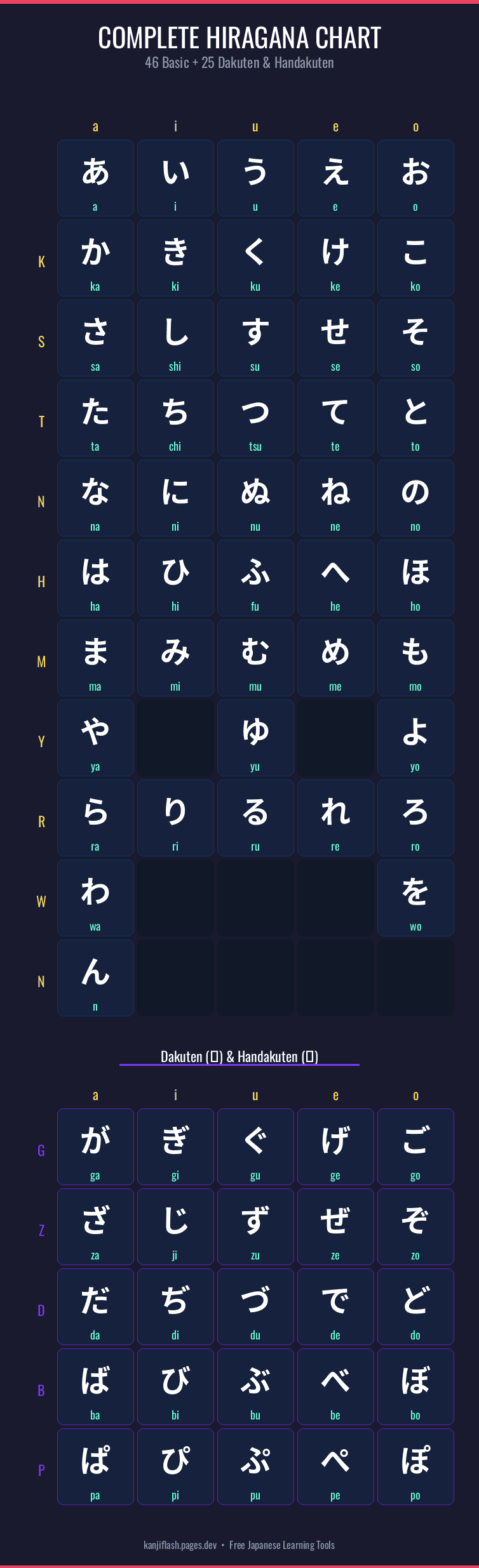
Below is the full hiragana chart with romaji readings. Right-click and save the image for a printable reference.
💡 Tip: Want to practice these characters interactively? Try Kana Flash — our free flashcard app with spaced repetition and audio pronunciation.
How to Read the Hiragana Chart
The hiragana chart follows the gojūon (五十音) ordering — literally "fifty sounds." Characters are organized in a grid:
- Columns represent the five vowel sounds: a, i, u, e, o
- Rows represent consonant groups: K, S, T, N, H, M, Y, R, W
To read any character, combine the row consonant with the column vowel. For example: K row + a column = か (ka).
The first row contains the five pure vowels, and the last entries are the special characters を (wo) and ん (n).
The 46 Basic Hiragana Characters
Vowels (母音)
Every Japanese syllable ends in a vowel sound. These five characters are the foundation:
| Hiragana | Romaji | Sound |
|---|---|---|
| あ | a | Like "a" in "father" |
| い | i | Like "ee" in "feet" |
| う | u | Like "oo" in "food" (lips relaxed) |
| え | e | Like "e" in "pet" |
| お | o | Like "o" in "go" |
Consonant Rows
Each consonant row adds its sound to the five vowels:
- Ka row (か行): か ki ku ke ko — Hard "k" sound
- Sa row (さ行): sa shi su se so — Note: し is "shi" not "si"
- Ta row (た行): ta chi tsu te to — ち is "chi" and つ is "tsu"
- Na row (な行): na ni nu ne no — Straightforward "n" sound
- Ha row (は行): ha hi fu he ho — ふ is between "fu" and "hu"
- Ma row (ま行): ma mi mu me mo — Standard "m" sound
- Ya row (や行): ya — yu — yo — Only 3 characters (yi and ye don't exist)
- Ra row (ら行): ra ri ru re ro — Between English "r" and "l"
- Wa row (わ行): wa — — — wo — Only 2 characters remain in modern use
- N (ん): The only consonant that stands alone — a nasal "n" sound
Tricky Pronunciations to Watch
Three sounds catch beginners off guard:
- し (shi) — Not "si." Think "she" with a shorter vowel
- つ (tsu) — Start with a "ts" sound, like the end of "cats" + "u"
- ふ (fu) — Blow air between lips without touching teeth. Softer than English "f"
Dakuten & Handakuten (Voiced Sounds)
Adding two small marks transforms consonants into voiced sounds:
- Dakuten (゛) — Two small strokes that voice a consonant
- Handakuten (゜) — A small circle that creates "p" sounds from the H row
| Change | Example | Sound Change |
|---|---|---|
| K → G | か → が | ka → ga |
| S → Z | さ → ざ | sa → za |
| T → D | た → だ | ta → da |
| H → B | は → ば | ha → ba |
| H → P | は → ぱ | ha → pa (handakuten) |
This adds 25 more characters (5 rows × 5 vowels), bringing the total to 71 hiragana.
These aren't new characters to memorize from scratch — if you know the basic hiragana, you already know what they look like. You just need to learn the voicing pattern.
Tips for Memorizing Hiragana Faster
1. Learn in Vowel Order
Always practice in the traditional order: a → i → u → e → o. This builds muscle memory and makes dictionary lookup intuitive.
2. Use Spaced Repetition (SRS)
Don't just stare at the chart. Use spaced repetition flashcards that show you characters right before you'd forget them. SRS is proven to be the fastest memorization method.
3. Write Each Character
Physically writing hiragana (even on a touchscreen) activates different memory pathways than just reading. Write each character 5-10 times when first learning it.
4. Group Similar-Looking Characters
Some hiragana look similar and get confused easily:
- は (ha) vs ほ (ho) vs ま (ma) — Similar shapes, different details
- ぬ (nu) vs め (me) — Both have loops
- わ (wa) vs れ (re) vs ね (ne) — Similar flowing shapes
Make a special study group for these confusing pairs.
5. Read Real Japanese Early
Even after learning just the vowels, start reading simple Japanese words. Seeing hiragana in context accelerates recognition far more than flashcards alone.
Recommended Practice Tools
- Kana Flash — Free hiragana & katakana flashcards with SRS, quizzes, audio pronunciation, and progress tracking
- Kanji Flash — Once you master hiragana, move on to JLPT N5 kanji
- Practice writing on paper or a touchscreen app alongside flashcard review
Summary
The complete hiragana chart has 46 basic characters organized in the gojūon grid, plus 25 dakuten/handakuten variations for voiced sounds. Master these 71 characters and you'll be able to read the phonetic backbone of Japanese.
Save the chart above for reference, then start practicing with interactive tools like Kana Flash to move from recognition to fluency. Most learners complete hiragana in 1-2 weeks with daily practice — you've got this.
📚 Related Articles
Frequently Asked Questions
How many hiragana characters are there in total?
There are 46 basic hiragana characters plus 25 dakuten/handakuten variations (ga, za, da, ba, pa series) and 33 combination characters (kya, sha, cha, etc.), totaling about 104 characters. The 46 basic characters are what you need to learn first.
What is the correct order to learn hiragana?
Learn hiragana in the traditional gojūon order: a-i-u-e-o, then ka-ki-ku-ke-ko, sa-shi-su-se-so, and so on. Learn the 46 basic characters first, then add dakuten (゛) and handakuten (゜) variations, and finally combination characters (きゃ, しゃ, etc.).
Is a hiragana chart enough to learn hiragana?
A chart is an essential reference tool, but you also need active practice — flashcard drills, writing exercises, and reading practice. Use the chart for quick reference while studying with apps that use spaced repetition for long-term memorization.
What is the difference between basic and dakuten hiragana?
Basic hiragana are the 46 core characters. Dakuten (゛) adds two small marks to change the consonant sound: ka→ga, sa→za, ta→da, ha→ba. Handakuten (゜) adds a small circle to the ha-row only: ha→pa. These are not new characters — just modified versions of basic ones.
Frequently Asked Questions
How many hiragana characters are there in total?
There are 46 basic hiragana characters plus 25 dakuten/handakuten variations (ga, za, da, ba, pa series) and 33 combination characters (kya, sha, cha, etc.), totaling about 104 characters. The 46 basic characters are what you need to learn first.
What is the correct order to learn hiragana?
Learn hiragana in the traditional gojūon order: a-i-u-e-o, then ka-ki-ku-ke-ko, sa-shi-su-se-so, and so on. Learn the 46 basic characters first, then add dakuten (゛) and handakuten (゜) variations, and finally combination characters (きゃ, しゃ, etc.).
Is a hiragana chart enough to learn hiragana?
A chart is an essential reference tool, but you also need active practice — flashcard drills, writing exercises, and reading practice. Use the chart for quick reference while studying with apps that use spaced repetition for long-term memorization.
What is the difference between basic and dakuten hiragana?
Basic hiragana are the 46 core characters. Dakuten (゛) adds two small marks to change the consonant sound: ka→ga, sa→za, ta→da, ha→ba. Handakuten (゜) adds a small circle to the ha-row only: ha→pa. These are not new characters — just modified versions of basic ones.